Wood Flooring Guide for London Properties
Everything London homeowners need to know about wood flooring — engineered vs solid, herringbone vs straight lay, underfloor heating, and period home considerations.
The First Decision: Engineered or Solid Wood?
This is the most important decision in any wood flooring project, and for most London properties, the answer is engineered wood. Here's why.
Solid Wood
Solid wood boards are exactly that — a single piece of timber all the way through. They can be sanded and refinished many times over decades, which is a genuine advantage. The problem is that solid wood moves. Timber expands when humidity rises and contracts when it falls. London's climate — humid in summer, dried out by central heating in winter — creates significant seasonal movement. This causes gapping between boards in winter and potential cupping or buckling in summer if the floor has been laid too tightly.
Solid wood cannot be glued to concrete, cannot be fitted below ground level, and should not be used with underfloor heating. In a city where basement conversions, underfloor heating systems, and concrete subfloors are common, these are serious limitations. Solid wood is best suited to period properties with dry, stable timber subfloors where there is no underfloor heating.
Engineered Wood
Engineered wood has a real wood veneer — anywhere from 2mm to 6mm thick — bonded to a core of cross-layered plywood. The plywood construction gives the board dimensional stability: it moves far less in response to humidity changes than solid wood does. This makes engineered wood suitable for concrete subfloors, underfloor heating systems, below-ground rooms, and the variable conditions of London properties built across three centuries.
Engineered boards can typically be sanded once or twice depending on the veneer thickness, which is sufficient for most residential properties. For a Marylebone townhouse, a Kensington flat, or a Chelsea mews, engineered wood is almost always the right choice.
Herringbone vs Straight Lay
Straight Lay
Boards run parallel to one wall (usually the longest). It's the simpler, faster installation. Waste is minimal — around 5% for offcuts. Straight lay suits contemporary and modern interiors and works well in rooms where you want a clean, uncluttered look. It's also less expensive than herringbone for the same floor area.
Herringbone
Short boards are laid at 45 or 90 degrees in a V-shaped pattern. The result is one of the most distinctive and traditional flooring patterns available, and it suits London's Georgian and Victorian housing stock exceptionally well. A herringbone oak floor in a Marylebone or Belgravia reception room looks exactly right — it's a pattern that has been used in these properties for over a century.
Herringbone requires more time to install. Each board must be cut at an angle at the room perimeter, generating more waste (typically 10–15%). A perfectly square room makes the job easier; irregular rooms require careful planning. The additional installation time and material waste make herringbone more expensive than straight lay, but the visual impact is substantial.
Chevron is a related pattern where boards are cut at angles so the points of the V meet perfectly rather than overlapping. It's slightly more contemporary than herringbone and particularly effective in long, narrow rooms like London hallways.
Underfloor Heating Compatibility
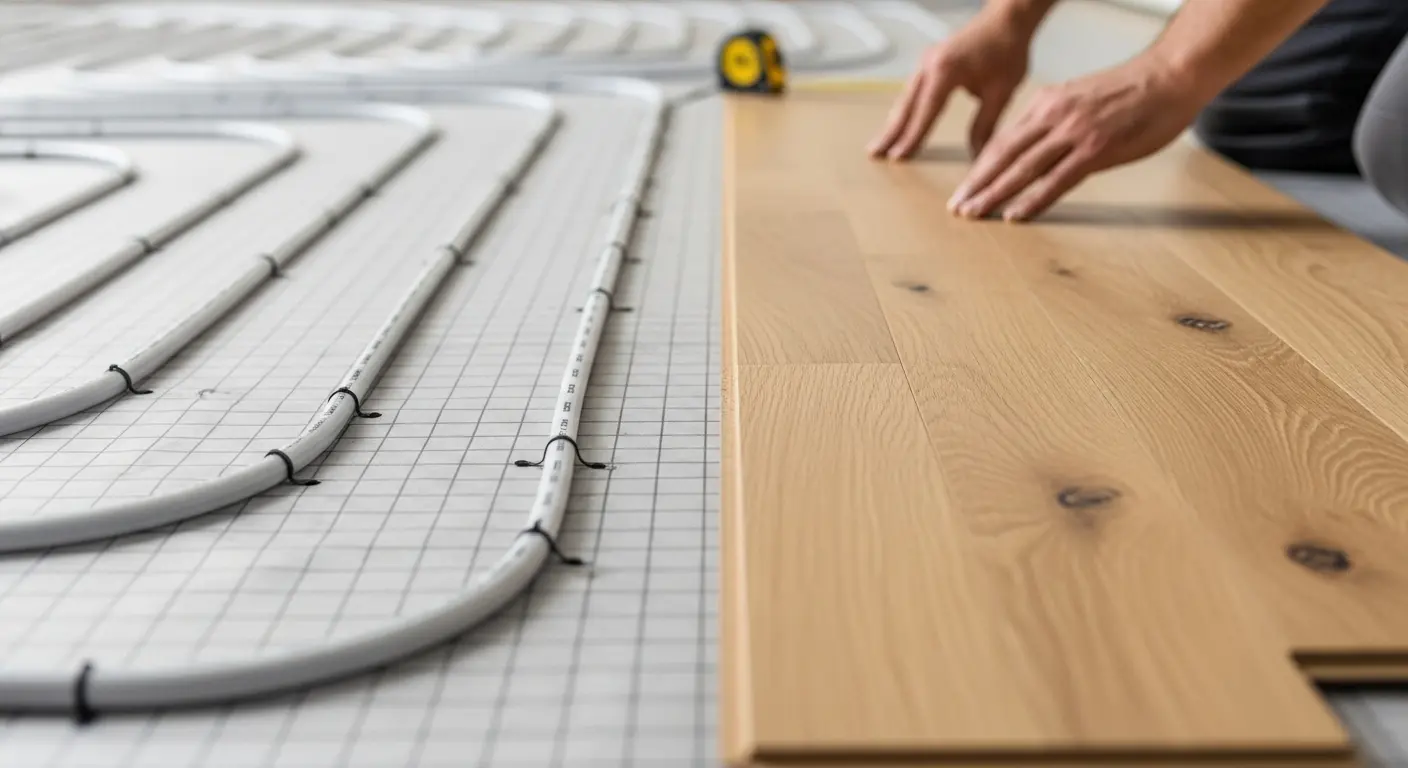
Engineered wood is compatible with most underfloor heating systems, but there are conditions. The maximum surface temperature should stay within the manufacturer's recommended limit — typically 27°C. Exceeding this causes the wood to dry out, leading to gapping and potential cracking.
Board thickness matters: thicker boards (over 18mm total) act as better insulators and slow heat transfer, making your heating system work harder. For best performance with underfloor heating, boards in the 14–18mm range are generally preferred. Use a low-resistance underlay or, for glue-down installation, no underlay at all — the adhesive itself forms a good thermal bond between the board and the heated subfloor.
We always check the underfloor heating manufacturer's specifications before recommending a specific floor product, and we can advise on the best combination during a free home consultation.
Wood Species and Finishes
Oak
Oak is the most popular wood species for flooring in the UK, and with good reason. It's hard, durable, and takes stains and finishes well. Oak's natural grain is attractive and versatile — it suits both traditional period interiors and contemporary Scandi-style designs depending on the finish applied. Graded from rustic (with visible knots, character marks, and colour variation) to prime (consistent, clear boards), there's an oak specification to suit every project.
Walnut
Walnut has a naturally rich, dark brown colour with a straight, fine grain. It creates a sense of warmth and luxury in reception rooms and living spaces. Softer than oak, it marks slightly more easily but many clients regard the patina that develops over time as a desirable quality rather than a flaw.
Ash
Ash is pale, with a strong, open grain. It produces the light, airy feel associated with Scandinavian interior design. It works well in modern London apartments where the aim is a bright, contemporary aesthetic rather than the warmth of oak or walnut.
Finishes
Lacquered: A clear protective coating sealed over the wood surface. Easy to clean, resistant to everyday marks, and requires minimal maintenance. The surface looks slightly more uniform than oiled wood.
Oiled: Oil penetrates the wood fibres rather than sitting on top. The floor feels more natural underfoot. Scratches can be spot-repaired by re-oiling the affected area rather than sanding the whole floor.
Brushed: The softer grain fibres are removed mechanically, leaving the harder grain lines slightly raised. This creates a textured surface that catches the light differently and hides minor scratches more effectively than a smooth finish.
London-Specific Considerations
Victorian and Edwardian London houses often have narrow hallways with uneven floorboards beneath. Engineered wood bridges minor undulations better than solid wood; significant irregularities may require a plywood overlay to create a flat, stable surface before laying. Basement conversions need a moisture test — concrete slabs in below-ground rooms often have residual dampness that must be addressed before any wood floor is installed. We check moisture levels on every site visit.
Getting Started
The best way to choose your wood or laminate floor is to see and handle samples in your own property. We bring samples to you as part of our free home consultation — oak, walnut, herringbone, straight lay, different finishes. We measure, assess the subfloor, check for underfloor heating, and give you a straightforward quote. Book a free home visit or call 020 7224 8876 to arrange a consultation at 31 Crawford Street, Marylebone.