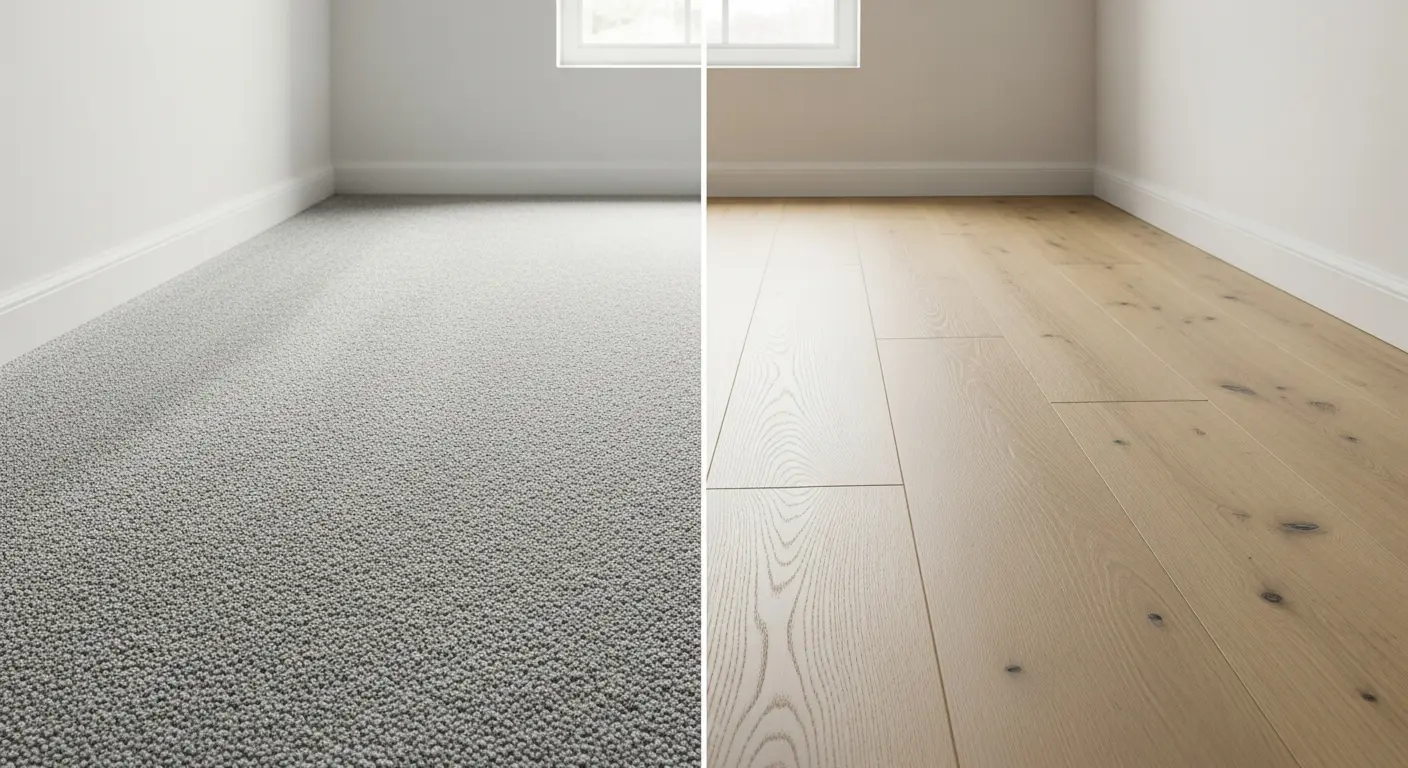
Engineered Wood vs Solid Wood Flooring: What's Best for UK Homes?
A detailed comparison for the UK climate. Understand the real differences between solid and engineered wood flooring, and which performs better in British homes.
Quick Takeaways
- Both are real wood - the difference is in construction, not quality
- Engineered wood is more stable and better suited to UK climate variations
- Solid wood offers marginally more refinishing potential (if you need 5+ sandings over decades)
- Engineered is essential for underfloor heating
- Quality engineered wood rivals solid wood in every way
Understanding the Fundamental Difference
The confusion between solid and engineered wood is one of the most common we encounter. Let's clarify once and for all:
Solid Wood Flooring
Exactly what it sounds like: planks machined from a single piece of timber. Typically 18-22mm thick. The entire thickness is the chosen species (usually oak, walnut, or ash). Can theoretically be sanded and refinished many times over its lifetime.
Engineered Wood Flooring
Multiple layers bonded together under pressure. A genuine hardwood top layer (wear layer) is adhered to a core of either:
- Plywood core: Multiple thin layers of wood with alternating grain direction. Provides excellent stability.
- HDF core: High-density fibreboard. Less expensive, suitable for floating installations.
Total thickness typically 14-21mm, with wear layers ranging from 2-6mm of real hardwood.
Why Construction Matters for UK Homes
Wood is hygroscopic - it absorbs and releases moisture from the air. When humidity rises, wood expands. When it drops, wood contracts. In the UK, we experience significant seasonal humidity variation, plus the dramatic changes caused by central heating.
The Problem with Solid Wood
A solid wood plank will expand and contract across its width (perpendicular to grain) far more than along its length. In winter, when central heating dries the air, solid wood planks shrink, creating visible gaps. In summer humidity, they swell, potentially causing cupping or buckling.
The thicker and wider the plank, the greater the movement. Wide solid oak planks (180mm+) are particularly problematic in heated British homes.
Engineered Wood's Advantage
The cross-grain layers in engineered construction counteract this movement. Each layer expands in a different direction, effectively cancelling out significant dimensional change. The result: far more stable flooring that maintains its appearance year-round.
This stability is why engineered wood is the only wood flooring suitable for underfloor heating and why it's preferred for wide plank formats (200mm+).
Wear Layers and Refinishing Reality
The theoretical advantage of solid wood is longevity through multiple sandings. But let's examine the reality:
Solid Wood
An 18mm solid oak floor can theoretically be sanded down to perhaps 12mm before the tongue-and-groove becomes compromised. This allows for 3-5 aggressive sandings over its lifetime.
Engineered Wood
A quality engineered floor with a 4mm wear layer can be sanded 2-3 times. With a 6mm wear layer, 3-4 times is possible.
The Reality Check
How often will you actually sand your floor?
- Most floors are sanded when they look tired - typically every 15-25 years
- Over a 60-year period, that's 2-4 sandings maximum
- By which time, fashion, family needs, or property changes often prompt replacement anyway
The refinishing advantage of solid wood, while real, is smaller than marketing suggests. A quality engineered floor with a 4mm wear layer will outlast most homeowners' tenure in a property.
Installation Considerations
Solid Wood
Must be nailed or glued to a timber subfloor or battens. Cannot be installed as a floating floor. Requires extensive acclimatisation (ideally 2-3 weeks in the room). More sensitive to subfloor moisture content.
Engineered Wood
Versatile installation options:
- Floating: Click-lock systems over underlay. Fastest installation.
- Glue-down: Adhered directly to concrete or ply. Most stable, essential for UFH.
- Nail-down: To timber subfloors, as with solid.
Shorter acclimatisation period typically required (1-2 weeks).
Where to Use Each Type
Solid Wood Works Best:
- Properties with consistent humidity (not reliant on central heating)
- Traditional installations on timber joists
- Where narrow planks (under 130mm) are desired
- Period restorations matching original floors
- Ground floors with good damp proofing (never in basements)
Engineered Wood Works Best:
- Any room with underfloor heating
- Concrete subfloors
- Wide plank formats (160mm+)
- Kitchens and dining rooms (humidity fluctuations from cooking)
- Basements and below-grade installations
- Open-plan living spaces
- Most modern UK homes with central heating
Get a Free Quote
Both engineered and solid wood are available in a wide range of qualities and specifications. Contact Yazco to discuss all wood flooring options. Call 020 7224 8876 for a free, no-obligation quote.
Installation requirements are similar, though engineered wood's floating option can simplify the process for straightforward installations.
Our Professional Recommendation
For the vast majority of UK homes, engineered wood is the superior choice. The stability benefits are genuine and significant in our climate. The refinishing 'compromise' is largely theoretical for most homeowners. And the installation flexibility (especially for underfloor heating) opens options that solid wood cannot match.
We install solid wood for clients who specifically request it - typically in period properties where authenticity is paramount or on ground floors without UFH where narrow-plank designs are desired. But when clients ask for our recommendation, engineered wood wins in 90% of London homes.
Conclusion
Don't think of engineered wood as 'fake' or a compromise. It's a superior engineering solution for the challenges of modern British homes. Focus on quality products with substantial wear layers (4mm+), choose a pattern and finish you love, and enjoy real wood flooring that stays beautiful year-round.